


Municipalities
The route proposes a journey through different signposted elements, with the aim of accompanying the visitor in the discovery of the architecture of Girona from the late nineteenth and early twentieth centuries. Beyond the set of selected buildings, the proposal aims to show the characteristic features of this heritage to identify it throughout the municipality.
The itinerary runs through the old quarter of the town and then goes to Avenida de Catalunya, following a circular route on foot that includes the first 12 buildings marked. The last three points of the route include the neighborhoods of Cal Bassacs, Viladomiu Vell and Viladomiu Nou; These can be visited in different ways: walking along the various paths that follow the course of the Llobregat river, along the route of the old train track or traveling by vehicle.
- Distance: Urban section 2km, neighborhood section 8.5km
- Time: Urban section 1h, neighborhood section 2h
- Signage: Monoliths with QR code to obtain more information about the buildings.
- Starting point: Pont Vell
Until the middle of the 19th century, life in the small town of Gironella continued to develop mainly on the left bank of the Llobregat river, within the old town. The economic and demographic boost provided by the textile factories was felt in the social vitality, but also in urban planning and in the construction of numerous buildings. The new and thriving Gironella, where the river became synonymous with wealth, expanded mainly on the other side of the river course, sheltered from the road from Sant Fruitós to Berga, and to the south, with the textile colonies. It is at this stage when the municipality acquires a large part of its current personality and appearance.
Of all the architectural wealth of Girona at this time, the itinerary highlights the residential character, although we find equally significant buildings for industrial use. There is a great variety of constructions, some of a noble character and others more modest, as well as a diversity of styles: modernist, historicist and others with a more eclectic or noucentist nature.
Two figures stand out in this panorama: Roc Cot i Cot (1865-1909) and Alexandre Soler i March (1873-1949), both held the position of municipal architect of the town and projected a good set of buildings in Gironella. Roc Cot y Cot was an architect of great versatility, a quality that allowed him to develop an eclectic style, alternating modernist works with others closer to the Noucentisme. It achieved great artistic expressiveness through the almost exclusive use of brick on the facades of some Girona buildings. Among the most prominent projects at the local level, we find Cal Claudi and Cal Vilamarí. However, a large part of his work was carried out in Berga and in Barcelona where he collaborated with Joan Alsina and Salvador Oller. Alexandre Soler i March developed his own style in which the influence of Domènec i Muntaner and his admiration for the medieval period, of which he was a passionate student, is evident. He is the architect of the new parish of Santa Eulalia and other buildings in the town are attributed to him, such as the Hotel (Av. Catalunya, 52) and the Torre del Amo del Cal Bassacs, an authentic jewel of Girona Modernism. His work has its epicenter in Manresa, although it also has projects of great relevance in Berga, Barcelona and Valencia.
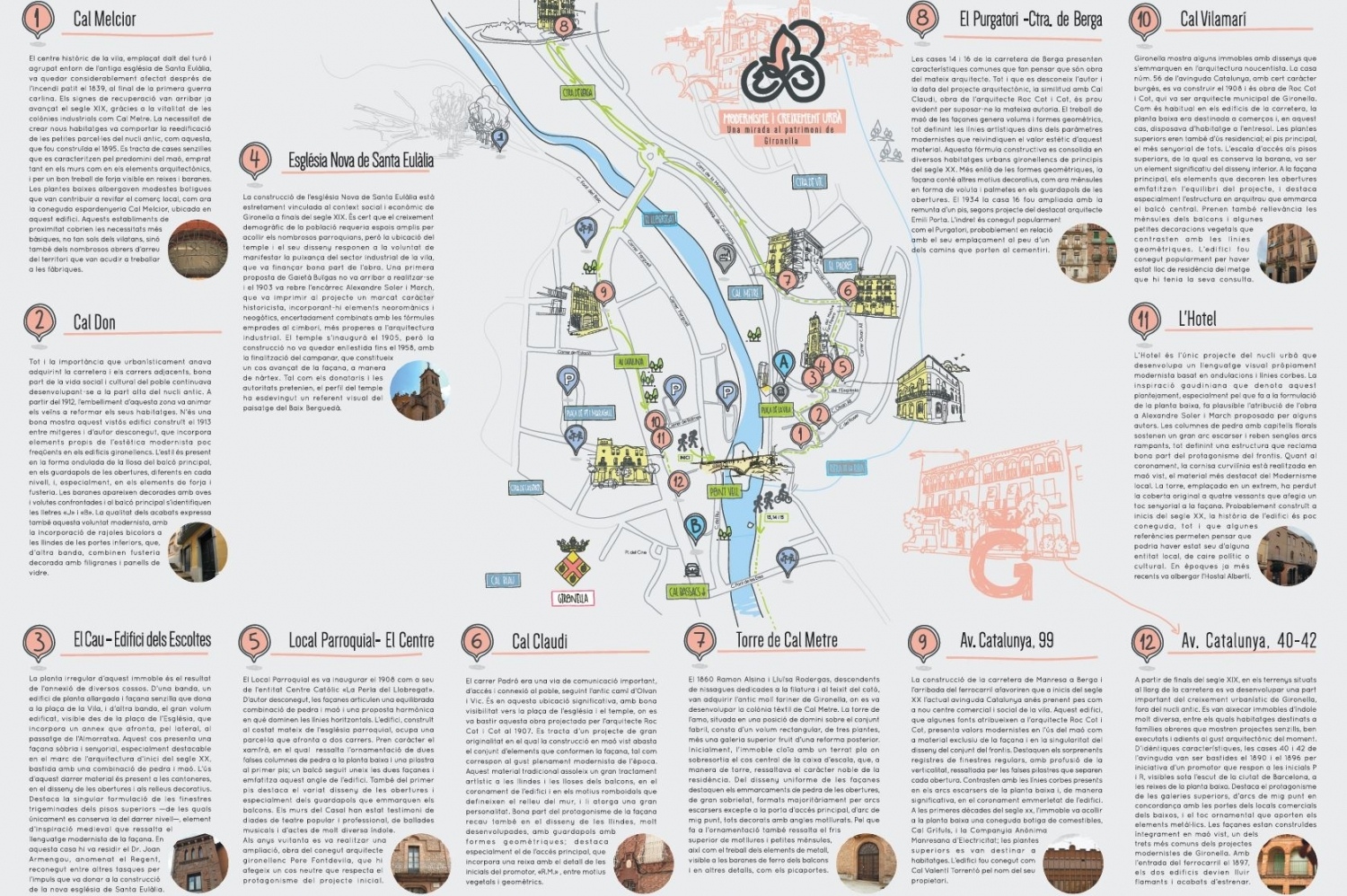
Itinerari ruta del modernisme de Gironella
Source: Gironella City Council
AD · RUTES_RUTA · Slot: 3740555068
Nearby experiences
Nearby routes
The Llobregat textile colonies by electric car, a world to discover
Berga, Gironella, Puig-reig
This route is designed to be done by electric vehicle, although it can be done with any other car. Along the route we will suggest municipalities that have charging points and places of interest to visit while we charge batteries. Electric…
Inclusive circuit in Gironella
Gironella
Beautiful, relaxing and inspiring tour. From the center of town we walk along the banks of the Llobregat river in its most beautiful part, the route is well signposted but you can also download the track to follow it. This route is a combination…
Route of the fountains of Gironella
Gironella
The circular route of the sources of Gironella, in the Berguedà, is a route created with the aim of increasing the offer of tourist areas of the municipality and complementing the future Via Azul del Llobregat. This route, based on the…
Related routes
Walk through the Noucentista chalets of Salou
Salou
The beginning of tourism in Salou is associated with modernism. Did you know? There are two factors that explain it. On the one hand, there is the fact that the first tourist buildings in the capital of the Costa Daurada were built in the twenties…
Sundials in Porrera
Porrera
This town, located east of the region of Priorat, in Tarragona, is known for two reasons. One, by the wine lands in which it sits, to the valley of the river Cortiella, which guarantees a rich vines and the existence of five renowned wineries…
Getting into the Terra Alta
Arnes, El Pinell de Brai, Gandesa, Horta de Sant Joan
The region of Terra Alta is the least industrialized area around the Ebro. It preserves a wide variety of unspoiled landscapes and towns that maintain the charm of the past. The most recent, the Battle of the Ebro, decisive chapter of the Spanish…
Route through Mont-Roig del Camp
Mont-roig del Camp
"All my work is conceived in Mont-roig." The appointment is neither more nor less than Joan Miró, universal Catalan, and the town to which it refers, Mont-roig del Camp, in the Baix Camp region. So if you want to know the streets and…
Events
Ulldecona cultural
7 NovemberOperation Castaween in Món Sant Benet
7 NovemberBalaguer Theatre's Autumn Cycle
7 NovemberNight of terror in Lliçà d'Amunt
7 NovemberAutumn Festivalet in Santa Susanna
7 NovemberSecond-Hand and Antiques Market in Tona
7 NovemberGuided tour of the Castell-Palau and the Old Town of Bisbal d'Empordà
7 November
News







 Sustainable turism
 Biosphere