


Municipalities
One of the most classic and essential routes of Catalan hiking. An emblematic route that many of us have engraved in our heads.
- Difficulty: easy. Very busy road and cemented sections with steps
- Elevation: 520 meters
- Time: 1h15' uphill (1h30' at an easy pace or 50' at a brisk pace) Between 1h15' and 2h back along the circular route.
- Kilometers: 11km
Variants: We can avoid a large part of the slope from the Sant Joan funicular. You can also connect from the Funicular de Sant Joan to the old path of San Jeroni to return through the same point. Apart from this, there are countless other variants, such as going to the viewpoint of the cross of Sant Miquel or the hermitage of San Joan, 15' from the funicular.
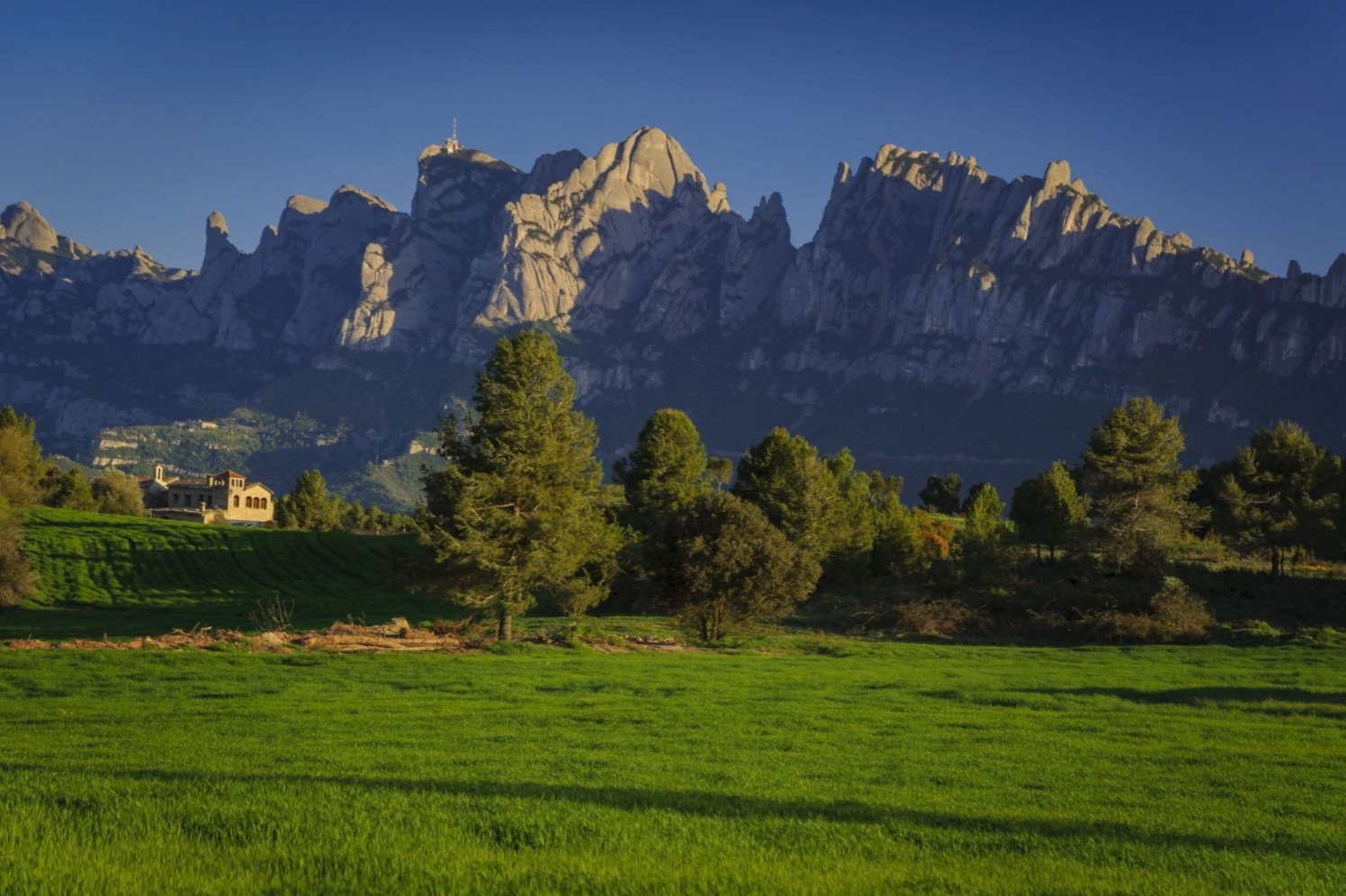
Foto: Vistas a las montañas de Montserrat desde un prado a Sant Salvador de Guardiola
We will leave the square of the Montserrat Monastery and we will go to the Montserrat enclosure. From there, we will go up the first steps next to a fountain from which we will take the Camí Vell de Sant Jeroni on the right, crossing the bridge. At this point we will begin a long ascent of steps that gradually ascends. A seemingly strong start but perfectly bearable! Approximately, it will be a 25-30 minute climb.
One of the most emblematic sections of this first part is the Pas dels Francesos, an area of steps wedged between two rocks that reminds us of one of the battles of the French War in Montserrat. Shortly after, we will arrive at the hermitage of Santa Anna, from where we could take a path that would take us to the funicular of Sant Joan, which is another good option that is quite flat and with excellent views.
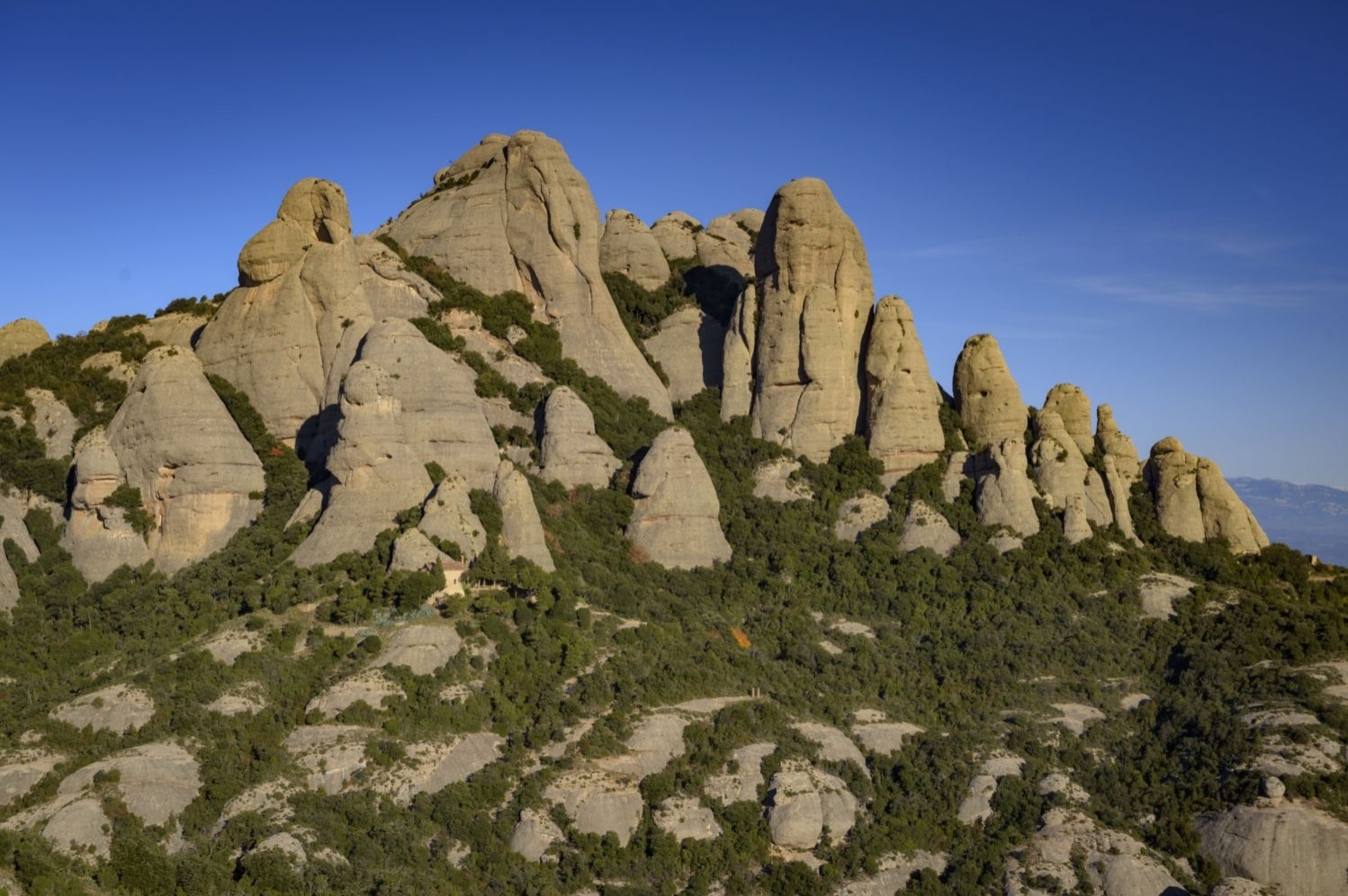
Foto: Vistas a las rocas del Elefant y la Mòmia desde la estación del funicular de Sant Joan
We will continue ascending, this time but for a more relaxed stretch. Above us we can clearly see the Panxa del Bisbe, a very apt name. From here, the path begins to flatten out and enters a forest of oaks known as El Pla dels Ocells. Indeed, the song of the birds is more than evident if we are lucky enough to be alone on that stretch. The path is not lost, although in some cases, natural streams and other trails deviate from the original path. After about 5 minutes from the beginning of the route, we will find a detour to the right that will allow us to climb the Miranda de Sant Antoni, to the magnificent Cavall Bernat viewpoint.
AD · RUTES_RUTA · Slot: 3740555068
Continuing upwards, after about 55 minutes from the start of our route, the path becomes steep again and shortly, it will join the Camí Nou de Sant Jeroni. From this point we will follow the same route both ascent and descent in the 20 minutes that separate us from the summit. After about 10 minutes of moderate ascent, we will arrive at the hermitage of Sant Jeroni, an ideal location to take a break and enjoy this wonderful plain. From here we can turn right, and in 10 minutes we will arrive at the Mirador del Moro, another beautiful viewpoint with views over El Serrat de les Onze and the old Sant Jeroni Air Station. We could also go down the Sant Jeroni canal.
We will finish the climb to Miranda de Sant Jeroni in just 10 minutes of climbing a hundred steps and a magnificent view of much of Catalonia.
We will make the return through the Camí Nou de Sant Jeroni, which will take us straight to the Sant Joan funicular. From there, we can go down on foot or take the same funicular. If we decide to do it on foot, we can follow a wide track that goes down to the hermitage of Sant Miquel (it is highly recommended to turn off to the Mirador de la Creu, just 5 minutes away). From there, in only 15 minutes we will find the Monastery.
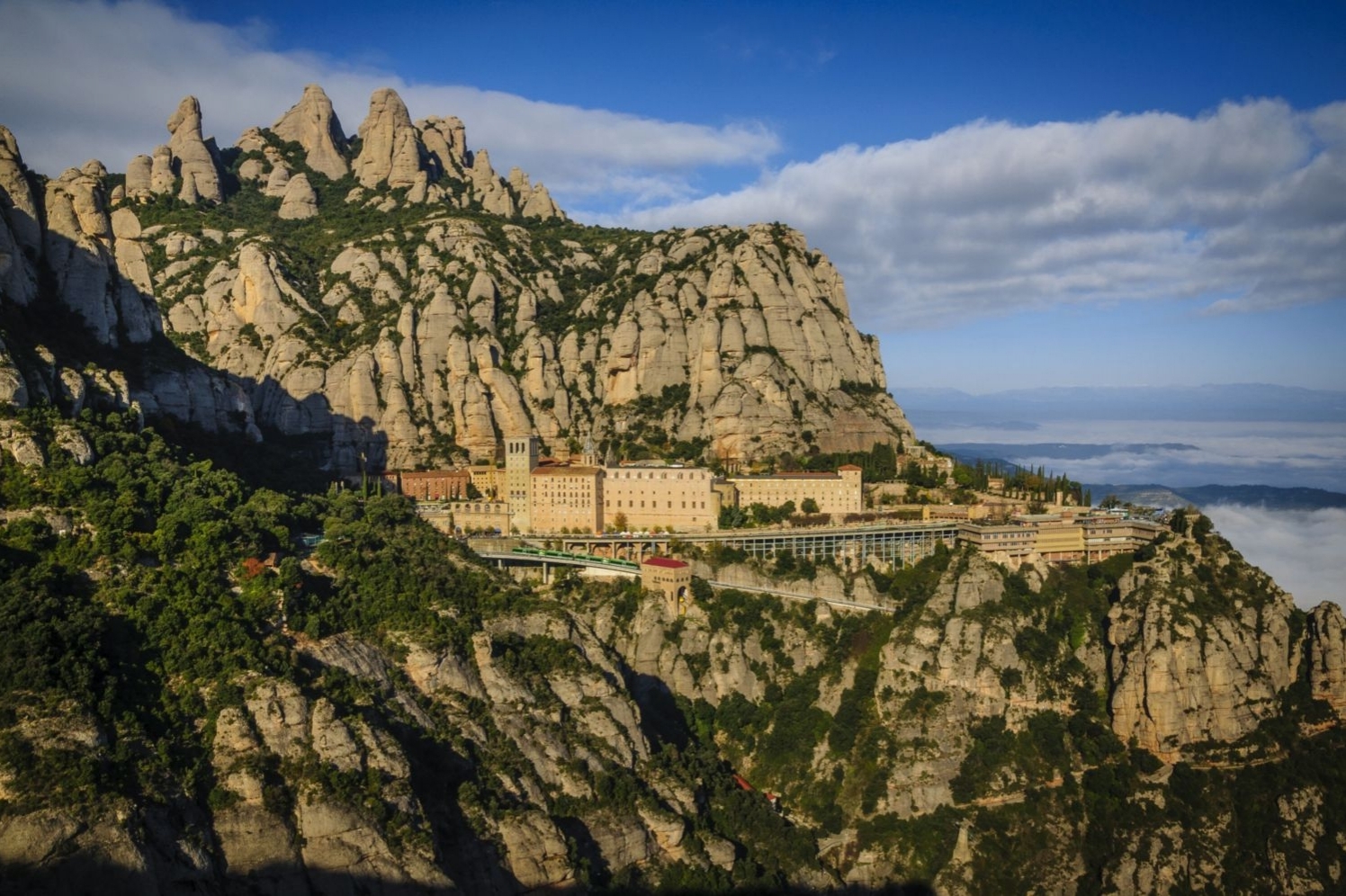
Foto: Vistas al Monesterio de Montserrat desde la Creu de Sant Jeroni
Once in the Monastery, do not forget to go and greet the Virgin of Montserrat!
Author images and text: Sergi Boixadeu
AD · RUTES_RUTA · Slot: 3740555068

Nearby experiences
Nearby routes
Montserrat, symbol of Catalonia
Collbató, El Bruc, Monistrol de Montserrat
Montserrat is much more than a mountain in the interior of Catalonia, it is a must-see symbol for all those who wish to delve deeper into the country, it is a natural park that we can enjoy with marked walks, it is a monastery with an active…
The route of the 3 mountains
Figaró-Montmany, Monistrol de Montserrat, Montseny, Mura, Rellinars, Sant Feliu de Codines, Sant Llorenç Savall, Tagamanent
The route of the 3 mountains is a journey that takes place on trails that hide Montseny natural parks, and Sant Llorenç del Munt and Montserrat Obac. Hence the reason for its name. This itinerary is a trip to the Catalan littoral which…
At the foot of Cavall Bernat de Montserrat
Marganell, Monistrol de Montserrat
It might seem that the least known and often wildest part of Montserrat is the westernmost area, between Can Maçana and Sant Jerònim. But between Sant Jerònim and the Monastery we also find very unprecedented routes and…
Related routes
Roca Corbatera (Montsant) from Sant Joan del Codolar (circular)
Colldejou
Its rugged appearance of limestone makes it have an imposing character despite its height of less than 1000 meters. Be that as it may, La Mola is one of the essential places in Camp de Tarragona to enjoy a great panoramic view of the south…
A high altitude walk through Cap de Creus
Roses
Circular route that will allow us to enjoy views of the north and south of Cap de Creus with all its scenic beauty from the highest part. We will enter the authentic flora of the Costa Brava and we will witness the passage of time. Difficulty:…
Following the river La Mugueta
Castelló d'Empúries, Peralada, Roses
How many times have we wanted to be seduced by nature? Or how many times we tried to be carried by the wind? And now, why do not we get carried away by the current of the river water Mugueta? FemTurisme This month we will give the necessary…
Circular route through the icons of La Garrotxa
Olot
La Garrotxa is one of the Catalan regions with the most spectacular and unique landscapes in the entire State, we would dare to say. And the fact is that apart from being practically all of it a natural park, few places in the world have such…
Events
Fun November in Guissona
7 NovemberRomanyam - Gavarres Gastronomic and Artisan Market
7 NovemberChestnut Festival - Children's Party at Fogars de la Selva
7 NovemberUlldecona cultural
7 NovemberOperation Castaween in Món Sant Benet
7 NovemberBalaguer Theatre's Autumn Cycle
7 NovemberNight of terror in Lliçà d'Amunt
7 November
News
Iron architecture: the light and steam of industrial Catalonia
In the 19th century, the Industrial Revolution not only changed the way people worked and lived, but also profoundly transformed architecture. The arrival of new materials, such as cast iron, wrought iron, and glass, opened up possibilities…
Gothic Architecture: The light and height of medieval Catalonia
Gothic architecture marks a turning point in the history of Catalonia. It was the style that transformed cities, places of worship, and the way people built collectively. A style that changed not only the stone itself, but also the way people…







 Sustainable turism
 Biosphere