


Municipalities
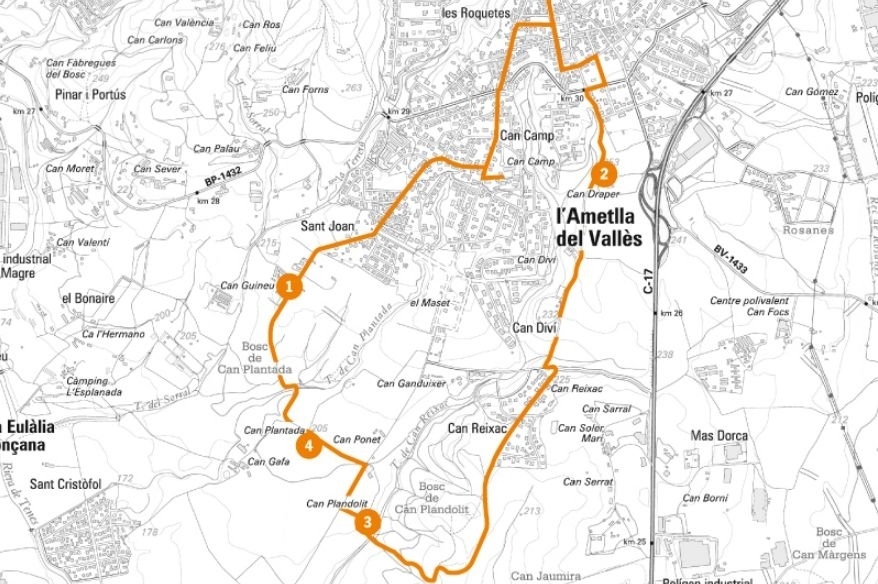
This tour is a walk through the most important farmhouses and the history of agriculture in the Ametlla del Vallès, the economic activity that has transformed the territory the most. It also introduces us into the life and personal circumstances of many refugees from the Spanish Civil War who found shelter in the village farms, leaving a historical testimony.
The total distance of the route is 6.3 km, with a vertical drop of 120 meters.
Approximate time: 2 hours and 15 minutes, low difficulty.
 Can Panedes
Farmhouse with an important agricultural tradition that still conserves this activity. Referred already in the thirteenth century, highlights an imposing era, built in the 20s of the last century. During the Civil War it welcomed several refugees although the written references have not registered the number.
Can Plan  tada
Farmhouse documented since the 12th century. The oldest part that is conserved is the kitchen and date of 1570. The lintel doorway, the sundial, the kitchen with large fireplace -with a stone center of Molí-, the huge dining room or the rooms with frescoes in the nineteenth-century walls are some of the elements that show its historical importance and power.
Highlights, among other elements, the square tower that houses the noble wing, built between the seventeenth and eighteenth centuries; the grotto, which served to keep food fresh; and the old kitchens, which served to accommodate refugees during the civil war.
AD · RUTES_RUTA · Slot: 3740555068
Can Plandolit
Masia of great majesty, referenced, for the first time, in the year 1132. It rises in an area dominated by the most powerful farmhouses of the Almond - the Plantada, Plandolit and Draper. It conserves a small part of the original nucleus, from the 12th and 13th centuries.
Most of the current building corresponds to the seventeenth century, when the most important extension of the house was made, which was consolidated until the mid-nineteenth century. It has a fortified district built around 1700. During the civil war , 5 refugees from Mequinenza, who arrived in April 1937 , hid themselves.
Can Draper
 One of the historical farmhouses of the Ametlla with more power, along with Can Plantada, Can Plandolit and Can Xammar de Dalt. It is a complex built between the 12th and 16th centuries, and built around a large central patio. It emphasizes the Gothic decoration in doors and windows and a tower of defense, of quadrangular plant and 4 levels.
About 100 meters north of the house is the raft-Drapera. This was filled with water from the Draper irrigation and supplied the garden raft, which has now disappeared. Between 1937 and 1939 there were 14 refugees from different areas of occupied Republican Spain.
Source: City Council of L'Ametlla del Vallès
AD · RUTES_RUTA · Slot: 3740555068

Nearby experiences
Nearby routes
Related routes
Isona: the reconstruction of a town between two fronts
Castell de Mur, Isona i Conca Dellà
One of the bloodiest episodes in the recent history of Catalonia has been the Spanish Civil War. Many Catalan towns were scenes and witnesses of confrontations and terrifying episodes, which are still present in the memory of their people,…
Route through the republican airfield of Bordils
Bordils, Celrà
The Bordils Airfield is a visitable space built at the end of 1936, considered one of the most important military airfields of the Republican Army in Catalonia during the Spanish Civil War. With an area of 126 hectares, it was built on agricultural…
The exile in the Jonquera, the route of the republicans towards France
Agullana, La Jonquera, La Vajol
The Civil War, that lasted from 1936 to 1939, meant the confrontation between the supporters and the opposers to the democratic government of the Republic. The conflict ended with the victory of opponents to the Republic, this end meant that…
Bicycle axis in Gallecs
Mollet del Vallès
Do you want to know the natural area of Gallegos on two wheels? This route fits perfectly with what you are looking for! It is a bike route that covers 15 km of medium difficulty for the entire rural environment of Gallecs. The exit is in the…
Events
Guided tours of the old town of Verdú
7 NovemberMIRA Digital Arts Festival
From 6 to 7 NovemberChestnut Fair in Maçanet de Cabrenys
7 NovemberFun November in Guissona
7 NovemberRomanyam - Gavarres Gastronomic and Artisan Market
7 NovemberChestnut Festival - Children's Party at Fogars de la Selva
7 NovemberUlldecona cultural
7 November
News








 Sustainable turism
 Biosphere